
FOR ANYONE WHO DESIGNS HOMES FOR PRIVATE CLIENTS
Your first meeting starts with a brief in hand.
Before they reach you, your client has a real conversation about how they want to live. You get it back as a written Home Brief.
It writes down what they need. It decides nothing.
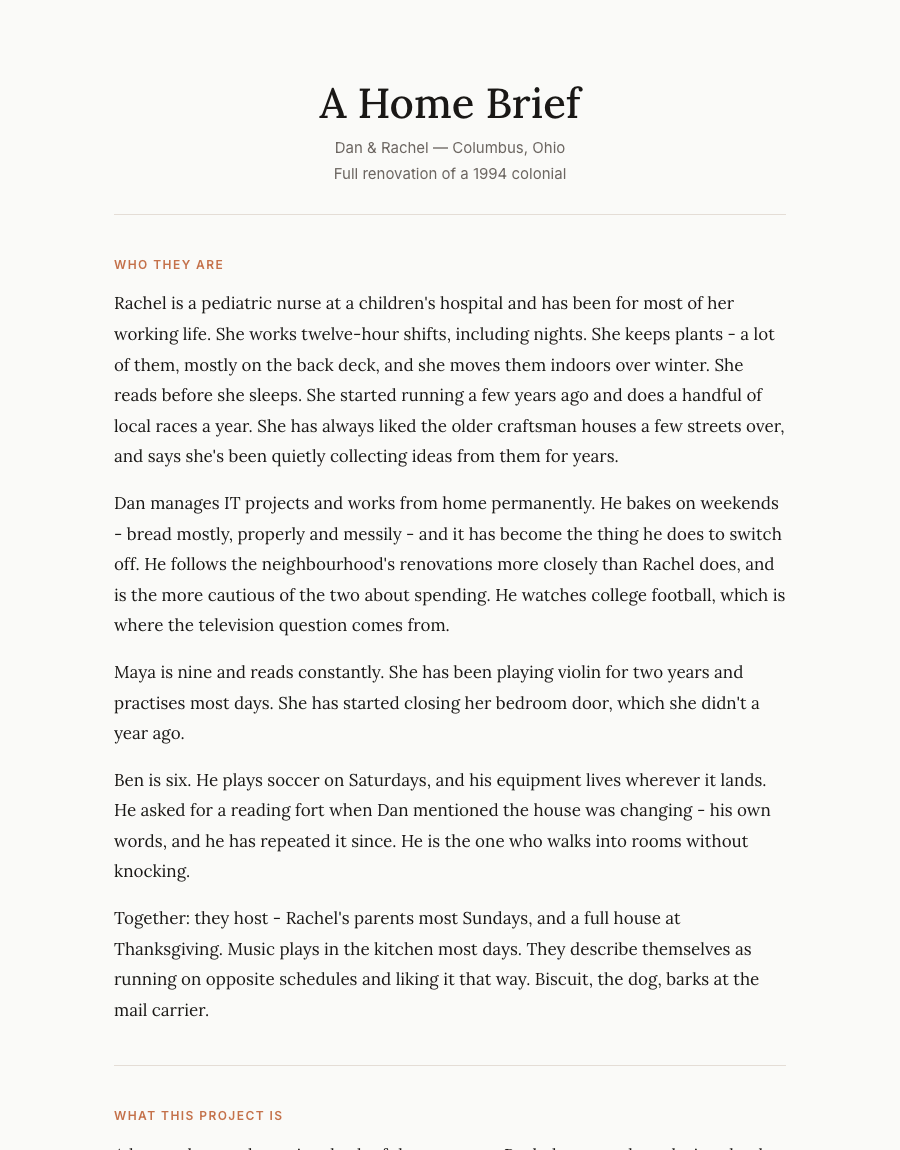
WHAT YOU ACTUALLY GET
A written Home Brief, in their words.
Seven sections, two to four pages. Not a form they filled in - a document built from a conversation. The questions came from people who do this for a living.
New-build briefs follow almost the same structure.
WHY THIS DIDN'T EXIST BEFORE
Programming isn't new.
Having someone else do it for one house is.
ON A HOSPITAL, A SCHOOL, A THEATRE, A LABA specialist develops the program before design starts.
ON A PRIVATE HOUSEIt has never been worth anyone's while. A consultant costs more than the whole fee. So the architect does it themselves.
That's what changed.
HOW IT WORKS
Send a link. Get a brief back.
They get a link to a Nestbrief conversation, in your studio's name.
At home, one question at a time. They can stop, think about something for two days, and pick up where they left off. Some of the most useful answers arrive that way.
When there are two of them, it puts questions to each of them by name - so what one of them thinks doesn't quietly become what both of them think.
By email, as a PDF or a Word file you can edit.
You can see where they are
The panel shows it for every client you've sent to. Nothing expires - no deadline on the link, and no deadline on the sessions you've bought. If someone leaves it for a week, it's still there when they come back.
"Your first meeting becomes refinement, not excavation."
Dana, architect
WHERE THE LINE IS
It records. It doesn't design.
It's an AI conversation, and we say that plainly. What it does is ask and listen. What it never does is decide.
Three things it will not do, in any session:
It doesn't propose solutions.
If a client says the kitchen feels cramped, it asks what happens in there and when. It doesn't suggest opening a wall, moving the island, or anything else. Those are yours to propose.
It doesn't settle disagreements.
Residential design comes with a role nobody trained for: sitting between two people who want different things. When that happens, it puts questions to each of them by name and puts both positions in the brief. Marked as open, not resolved. You get the full picture, and you decide.
It doesn't give design advice.
It gets what they like in their own words - the room they can't stop thinking about, the light they want in the morning, the house down the street they've always admired. Yours to interpret.
A FORM CAN'T ASK A SECOND QUESTION
You send a form. We have a conversation.
A form gets what the client thinks to write down. It can't ask what they meant, notice what they skipped, or come back to it later.
Ask for storage and you get "more storage." Ask why, and you find out the air fryer lives in the basement and the cereal lives on top of the fridge - so you get the full picture of what's actually failing, not the headline.
A form ends when they hand it back. A conversation goes deeper, and brings out things they hadn't thought to mention.
"I'm not worried about AI. Clients would have to clearly say what they want - and I have never had a client that can do that."
An architect, in a public discussion
YOUR NAME ON IT
Your client sees your studio.
Set your studio name once. Your client sees it in three places:
They get a link from you. You get the brief back.
Halstead ArchitectureYour studio name · alongside the Nestbrief logo
WHO BUILT THIS
I've been on the other side of this since I was a kid.
My father ran a business in the trades and I grew up in it. Then I spent eight years as a licensed renovation contractor, watching drawings change late because something about how the client lived only surfaced once there was something to react to.
The profession has a word for the gap: back-briefing. On large projects a separate consultant handles it. On a private house it has never been worth anyone's while.
I built this with an architect, and refined it with designers and contractors.

PRICING
What it costs.
Prices shown before tax. Sales tax added at checkout.
Running a larger studio? Let's set you up with a plan that scales. Talk to us →
COMMON QUESTIONS
Questions we get
Anyone who designs homes for private clients - architects, building designers, design-build firms. Homeowners also use it directly, and bring the brief to whoever they've hired. If you sit across from someone at the start of a project and have to work out what they want, it's for you.
Yes. The sample on this page is a renovation, and a new build brief follows almost the same structure - the difference is that a renovation starts from a house that already exists, so there's more about what's failing now and what the building will allow.
No - it gives you a fuller picture to start from. Instead of assembling that picture yourself across the whole process, a piece at a time, it's in front of you before you begin. You start designing earlier, and you can see the whole thing at once - so you choose where to go deeper, instead of finding out late that you should have.
Yes. And this is one of the things it's genuinely good at: holding a conversation, following an answer with the right next question, and pulling out detail that people don't think to volunteer. Research on conversational interviewing found people rate a well-run AI interview as comparable in quality to a human one - the difference is that this one has all the time in the world. It's a conversation with clear limits. It runs in one direction: getting a full and honest picture of your client. Not designing, not advising, not deciding. So what reaches you is a real brief - comprehensive, in their words, and yours to work from.
No. Not once. No materials, no layouts, no opinions about what would work. If a client says a room feels cramped, it asks what happens in there and when. The suggesting is yours.
Then change it. It's your input, not a ruling. It records what your clients said they need - the judgment about what that means, and what gets built, stays entirely with you.
It follows up where it matters, and pushes for the specific over the general. And where an answer stays thin, the brief says so rather than filling the gap. You'll know what's solid and what isn't.
A form gets one answer per question and stops there. A conversation takes that answer and asks the next question from it, and the one after that - so what comes back is broader, and the understanding underneath it is deeper. It also puts questions to each partner by name, which a shared form can't do. And there's no meeting around it - they can stop, think about something for two days, and come back. Some of the most useful answers arrive that way.
A complete written picture of your clients - who they are, the facts, risks, how they live, the program, what they're open to, and what's still open. Two to four pages, built from their own answers. How you get it: access to a panel, where you send each client a link to a Nestbrief conversation. When they've finished, the brief arrives by email, as a page you can open, and as a Word or PDF file you can download.
They open the invitation you send from your panel, and answer questions - about how they live, what works and what doesn't, what they need from the house and why. It's a conversation, not a form. At the end they get the finished brief, and so do you. At home, in their own time. No account, no software, no payment. They can stop and come back when they're free and ready to answer.
As long as they need. Most work through it in one or two sittings, and it saves as they go.
You and your client. We don't sell data, and we don't show one client's brief to anyone else - the sample on this page is exactly that: a sample.
No. Not the ones you buy, and not the links you send.
Unused sessions are refundable within 30 days, repriced to the tier you actually used.
Yes. A single session is the same product as a pack - buy one, send it to a real client, and see what comes back.
A real conversation, before they ever reach you.
They arrive knowing themselves better.
You start several steps ahead - with room to go deeper.
CONTACT US
Want to talk it through first?
Book a call and we’ll walk you through it - how it works, whether it fits your practice, and anything you want to ask. Prefer email? Reach us directly at hello@nestbrief.com.
Or email us directly at hello@nestbrief.com.